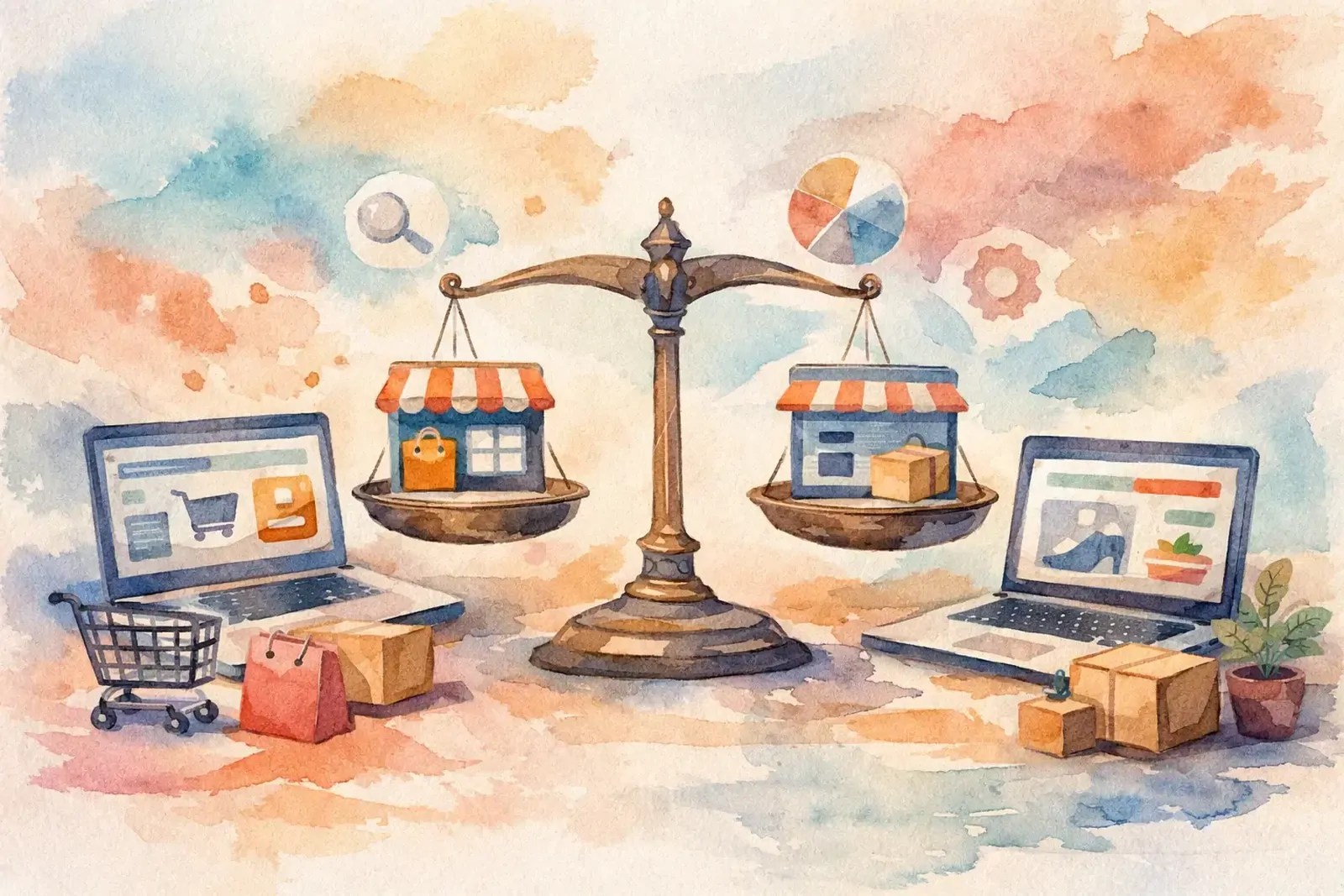
How to Compare E-commerce Infrastructures
Choosing the wrong infrastructure for an e-commerce project often goes unnoticed at first. The real cost becomes apparent when order volumes increase, ERP integration becomes necessary, different pricing rules are introduced, or campaign traffic rises. Therefore, an e-commerce platform comparison should not be based solely on theme appearance or monthly subscription fees. The decision should consider operational requirements, growth objectives, technical dependencies, and long-term management capabilities together.
For corporate businesses, an e-commerce website is more than a digital sales channel. It is a business system that supports dealer networks, organizes inventory and order processes, manages customer experience, and measures the conversion performance of marketing investments. The infrastructure behind this system directly affects the speed and flexibility of the business model.
The Right Framework for Comparing E-Commerce Platforms
Solutions available in the market can generally be categorized into ready-made SaaS platforms, licensed software packages, open-source solutions, and custom software development models. Each model has its strengths, but not every model is the right choice for every business.
Ready-made SaaS solutions offer advantages such as rapid implementation, standard security updates, and lower initial investment costs. They can be particularly suitable for businesses starting with a limited number of products and using standard shipping and payment processes. However, limitations in flexibility may become apparent when advanced B2B pricing, custom order approvals, multiple warehouse scenarios, or organization-specific integrations are required.
Licensed software packages can provide a practical starting point in terms of local payment systems and marketplace integrations. However, licensing, modules, maintenance, version upgrades, and custom development costs should be clarified at the beginning of the project. A low initial quotation does not necessarily mean a low total cost of ownership.
Open-source solutions offer extensive customization capabilities. However, they require an experienced technical team to manage updates, security, performance, and plugin compatibility. As control increases, management responsibilities also increase. Custom software, on the other hand, is suitable for organizations whose business processes cannot be accommodated by standard packages. Although this model generally requires greater investment and longer development time, proper analysis and planning can produce a system more closely aligned with corporate operations.
What Are the Key Decision-Making Criteria?
Rather than relying on a single score when selecting an e-commerce platform, it is more effective to evaluate requirements through a weighted decision-making model. For example, rapid market entry may be critical for one brand, while ERP integration, dealer management, and inventory synchronization may be significantly more important for a manufacturing company.
Integration Capacity
One of the most important tests of an e-commerce platform is how effectively it communicates with other systems within the organization. Data flows involving ERP, accounting, CRM, PIM, shipping providers, marketplaces, payment service providers, and call center software should be evaluated.
Simply asking whether an integration is available is not sufficient. It is necessary to determine whether the integration operates in real time or at scheduled intervals, how inventory, pricing, order cancellations, and return data are transferred, and who is responsible for resolving errors. API documentation, data security, and custom integration development capabilities should be reviewed at the beginning of the project.
Performance and Scalability
Page loading speed affects both user experience and organic search visibility. Particularly during advertising campaigns, seasonal promotions, or B2B ordering periods, the website must be capable of handling high levels of simultaneous traffic. CDN usage, caching strategies, image optimization, and server resources become especially important in this context.
The number of products alone is not an adequate performance indicator. Tens of thousands of products, numerous variants, different customer groups, and dynamic pricing calculations can significantly increase system load. A platform that performs quickly in a demonstration environment may not deliver the same results with real data volumes. Whenever possible, reference projects should be evaluated based on similar industries, product volumes, and traffic levels.
Security and Access Control
Payment data, customer information, and commercial pricing are among an organization's most sensitive digital assets. An SSL certificate is a fundamental requirement, but it does not constitute a complete security strategy. Regular backups, access logs, two-factor authentication, role-based user permissions, security updates, and attack prevention measures should all be evaluated.
Particularly in multi-user environments, giving everyone the same level of access to the administration panel creates significant risks. Access permissions for sales teams, warehouse personnel, content managers, and finance departments should be separated according to their responsibilities. Personal data protection processes should also be designed by considering both the technical infrastructure and operational procedures.
Total Cost of Ownership
Monthly or annual subscription fees represent only the first line of the overall cost structure. Theme customization, custom modules, integrations, hosting, maintenance, security, support, payment processing commissions, version upgrades, and content operations all contribute to the total budget.
For this reason, suppliers should be asked to provide an estimated cost projection covering at least three years. It should be clearly documented which services are included in the standard package, which developments require additional fees, and how support requests are priced. A low initial investment may become an expensive choice in the medium term if frequent custom development is required.
Ease of Management and Support Model
A simple administration panel is valuable, but not every interface that appears straightforward can meet corporate requirements. Product management, campaign configurations, customer segments, return processes, coupons, content areas, and reporting screens should be tested with actual users.
Service levels should also be clarified regarding technical support. What is the response time when a critical order or payment issue occurs? Is support provided exclusively through a ticketing system, or is there a dedicated technical team that takes responsibility? Regular improvements, performance monitoring, and planning for new requirements after project delivery are essential for long-term success.
B2B and B2C Requirements Are Different
In B2C sales, rapid product discovery, mobile experience, campaign management, and convenient payment processes are key priorities. In B2B e-commerce, customer-specific pricing, discount rates, payment terms, quotation requests, minimum order quantities, dealer permissions, and approval workflows may be more critical.
For example, an industrial company may prefer to sell under conditions defined for specific customer groups rather than displaying a public price list. Different purchasing authorities, budget limits, or purchase approvals may be required for the same customer. A standard B2C platform may partially support these processes through plugins. However, if these workflows are central to the business, custom development or a solution with advanced B2B capabilities may be more appropriate.
Questions to Ask During the Demo Process
The decision-making team should test real usage scenarios rather than relying solely on sales presentations. Provide the supplier with examples based on your own products, customers, and operational structure. Evaluate together how long it takes to add product variants, define dealer pricing, transfer a canceled order to the ERP system, or generate reports during a promotional campaign.
Obtaining clear written answers to the following four questions will improve the quality of the decision:
- What is the standard scope of the required integrations, what are their technical limitations, and who is responsible for them?
- How will the platform scale as traffic increases, product volumes grow, and new user requirements emerge?
- What service levels will apply to security updates, backups, error monitoring, and emergency response?
- What will the total three-year cost be, including licensing, development, maintenance, and support?
Plan Your Infrastructure Together with Marketing and Analytics
The technical structure of an e-commerce website cannot be considered independently of SEO and advertising performance. Category and product pages must be editable, filtering structures must be properly configured for search engines, conversion tracking must be supported, and campaign landing pages should be easy to create.
It is possible to attract traffic through Google Ads, social media advertising, and email automation. However, a website that loads slowly on mobile devices, displays inaccurate inventory information, or creates difficulties during checkout will reduce the efficiency of advertising expenditure. Therefore, platform selection should involve a joint evaluation by design, software development, analytics, and digital marketing teams.
Invilon's approach brings requirements analysis, technical architecture, and performance objectives together within a unified plan. Rather than treating the infrastructure as a one-time project delivery, it considers it a digital investment capable of adapting to evolving business requirements.
The right solution is not necessarily the system offering the greatest number of features. It is the infrastructure that enables your business to operate smoothly today while adapting in a controlled manner to new sales channels, integrations, and customer expectations tomorrow.
Photo Gallery