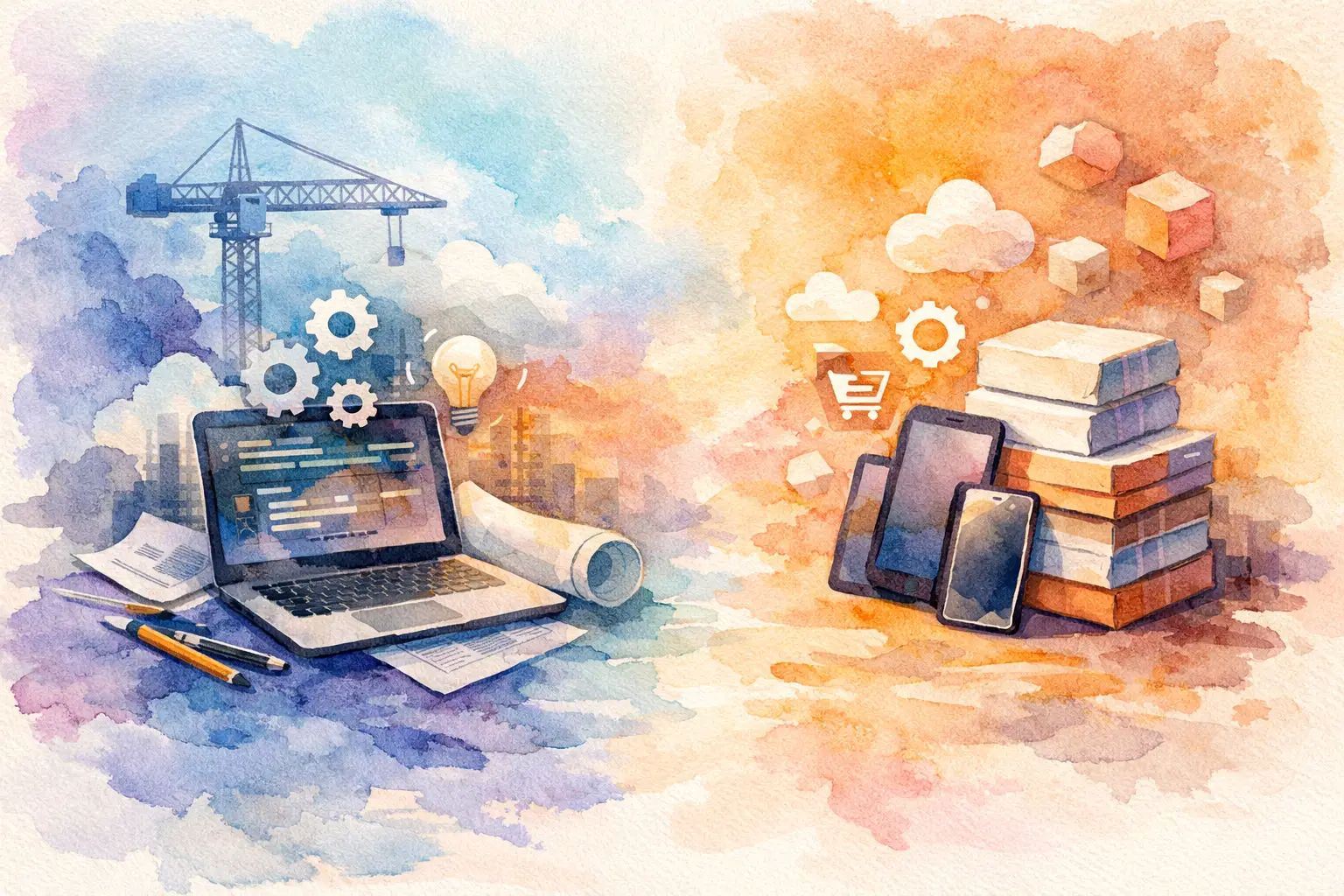
Custom Software or Ready-Made Package?
For an organization, software investment is often seen as a purely technical decision. However, the question of custom software vs ready-made software directly affects everything from operational efficiency and customer experience to reporting and growth capacity. A wrong choice can lead to years of additional costs, process bottlenecks, and integration issues. A correct choice, on the other hand, creates a sustainable digital infrastructure aligned with the way the organization actually operates.
There is no single correct answer in this decision. Every organization has different business models, internal processes, decision-making structures, budget frameworks, and growth targets. Ready-made software can deliver fast results for certain needs, while custom software provides more control, flexibility, and a structure tailored specifically to the organization. To make a sound decision, it is essential to first clearly understand what both approaches represent.
Why is the “custom software vs ready-made software” question critical?
Ready-made software is a standardized product developed for general use cases and designed to serve a large number of users. It is commonly used in areas such as accounting, CRM, e-commerce infrastructure, HR, or project management. Its advantages are clear: faster deployment, generally lower initial cost, and a mature product structure that has been tested by many users.
Custom software, on the other hand, is developed from scratch or through a tailored architecture based on the organization’s workflows, approval mechanisms, user roles, reporting structure, and integration needs. The goal is not to adapt the company to the system, but to design the system according to the company’s way of working.
This distinction is especially important for corporate companies and public institutions. In these environments, processes are rarely standard. Multiple departments, different authorization levels, ERP or accounting integrations, custom reporting requirements, and compliance-driven operations are common. At this point, software becomes not just a tool, but the backbone of the entire operation.
When is ready-made software the right choice?
Not every organization needs custom software. If the requirement is clear, widely standardized in the industry, and relatively simple, ready-made solutions can be more practical. For example, basic customer tracking, standard e-commerce operations, simple inventory management, or common office workflows can often be handled effectively with off-the-shelf tools.
The strongest advantage of ready-made software is speed. It can be deployed without long analysis, design, and development cycles. This is particularly valuable for startups or teams that want to validate an idea quickly. In addition, maintenance, updates, and basic support are typically provided within a structured vendor system.
However, it is important to understand that solving today’s needs does not guarantee long-term suitability. A system that works well initially may become restrictive as user numbers grow, reporting requirements become more complex, or integrations with other systems are needed.
Which organizations are better suited for custom software?
If an organization’s processes differ significantly from standard industry models, custom software provides a strong advantage. It is particularly effective in manufacturing, logistics, field operations, dealer management, quotation and approval workflows, custom CRM systems, or environments where multiple systems need to be centralized.
The core strength of custom software is alignment. You do not adapt your processes to the software; the software is designed around your operations. This reduces friction in daily workflows, minimizes manual work, and increases efficiency.
Another key advantage is scalability. As the organization grows, new modules can be added, existing functions can be extended, new user roles can be defined, and custom reporting dashboards can be built in a controlled way. This is especially important for companies with long-term digital transformation plans.
Cost comparison: Initial price vs total cost of ownership
One of the most common mistakes in this decision is focusing only on initial cost. Ready-made software may appear more affordable at the beginning. However, additional user fees, module licenses, integration costs, customization requests, and operational inefficiencies when the system becomes insufficient can significantly increase the total cost over time.
Custom software requires a higher initial investment. Analysis, architecture design, UI/UX design, development, testing, and deployment require more resources. However, in the long term, reduced dependency on licenses, elimination of unnecessary features, and a structure built directly for organizational needs can make the total cost of ownership more efficient.
The real question is not which option is cheaper today, but which option will be more efficient and sustainable in three years.
Integration and data management differences become significant
Organizations rarely operate on a single system. Websites, CRM, ERP, accounting tools, call centers, mobile applications, inventory systems, and reporting platforms often coexist in the same ecosystem. While ready-made software may support standard integrations, not every organization has the same data flow requirements.
Custom software provides flexibility in this area. It allows full control over how data is collected, processed, displayed, and reported. This is a major advantage for companies that aim to centralize fragmented data structures.
This difference becomes especially visible in management reporting. Ready-made systems usually limit users to predefined reports, while custom software allows decision-makers to define exactly the metrics they need based on how the organization operates.
Security, authorization, and control
In corporate environments, security is not just a technical feature. It includes role-based access, audit logs, data visibility rules, internal approval flows, and compliance requirements. Ready-made software can provide baseline security standards, but it may not match the depth required by every organization.
Custom software enables more granular control. From user roles and approval chains to data visibility and transaction logs, everything can be designed according to internal policies. This is particularly important for public institutions, companies handling sensitive data, and complex organizational structures.
However, security in custom software is not automatic. It depends on proper architecture, testing, infrastructure management, and ongoing maintenance. In other words, both the choice and the execution quality matter.
The key questions behind the decision
The decision between custom and ready-made software should be made at the management level, not only by technical teams. The issue is not just what the software does, but how the organization operates. If processes change frequently, if multiple approval layers exist, if integration with different systems is required, and if operational differences create competitive advantage, custom software is often the stronger choice.
On the other hand, if requirements are standard, fast deployment is a priority, and low initial cost is important, ready-made software may be more suitable. However, its limitations should be clearly understood from the beginning.
A proper evaluation should consider: how unique your processes are, your two-year growth plans, required system integrations, complexity of user roles, and whether reporting needs are standard or customized. Without clarity in these areas, decisions are often incomplete.
Sometimes the best solution is a hybrid model
In practice, not everything is black and white. For some organizations, the most efficient solution is neither fully custom development nor fully off-the-shelf software. A hybrid approach can be more effective.
For example, core operations such as quotation systems, dealer management, or operational workflows can be custom-built, while standard services like email marketing tools, basic HR systems, or certain reporting tools can be handled with ready-made solutions. The value of an experienced technology partner lies in designing this balance correctly. The goal is not to sell software, but to build the right architecture for the organization.
A good decision is not about choosing the most popular solution. It is about building a structure that can support both today’s operations and tomorrow’s goals. Software decisions should never be rushed. When made with the right analysis, they do not only solve a need—they strengthen the organization’s capacity to grow.
Photo Gallery