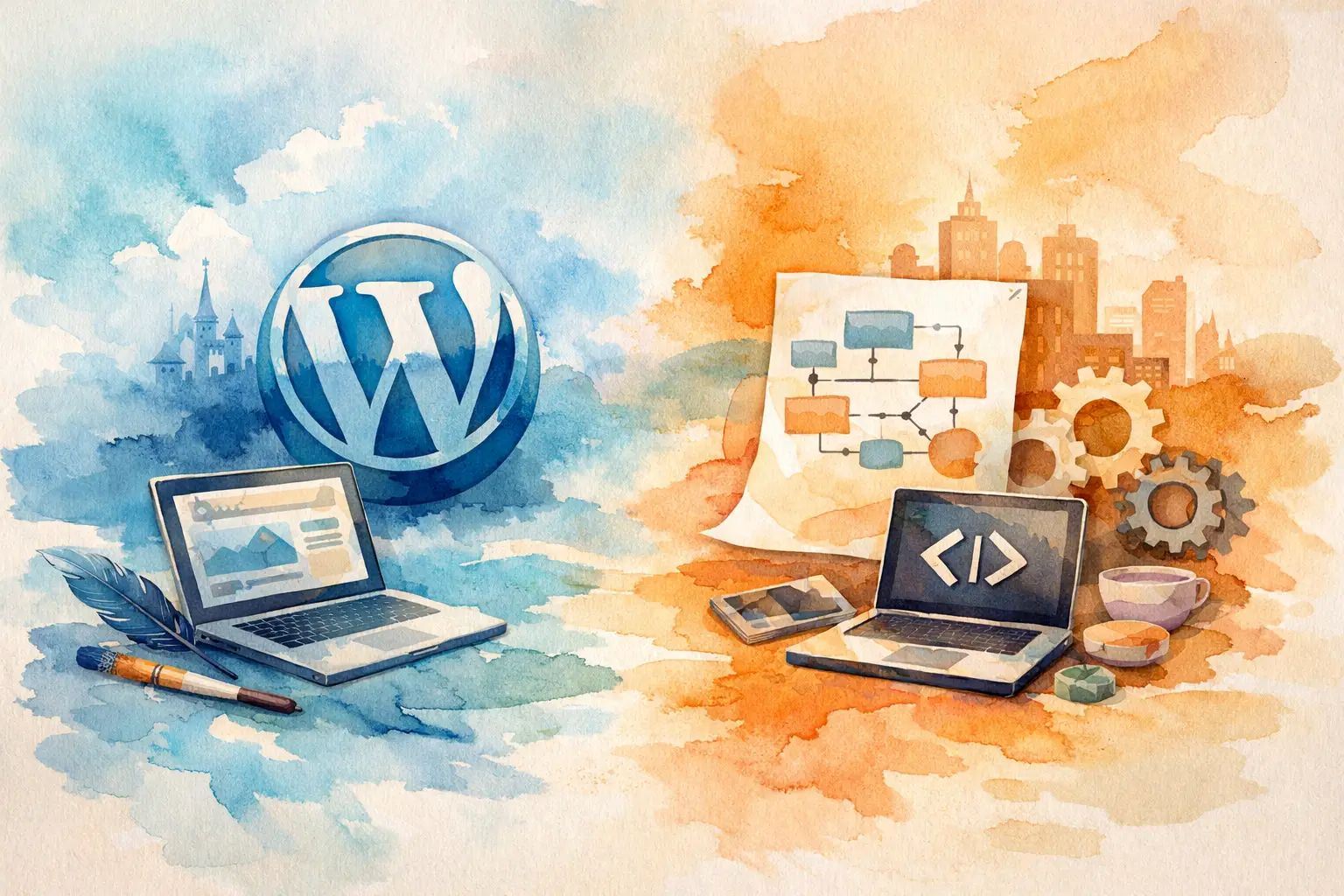
WordPress or Custom Software
One of the most expensive mistakes in a web project is choosing the wrong technology. Because the issue is not simply launching a website. The real challenge is building a structure that meets your company’s current needs without creating operational problems in the future. That is why the question of “WordPress or custom software?” is not a design preference, but a direct decision about business model sustainability and long-term scalability.
Why Is the “WordPress or Custom Software?” Question So Critical?
For corporate companies, manufacturing businesses, service providers, and public institutions, web infrastructure is no longer just a digital showcase. A website often carries multiple processes such as quotation collection, application management, dealer communication, content management, reporting, integrations, and digital marketing performance.
For this reason, the chosen infrastructure affects not only the software team but also the performance of marketing, operations, sales, and management departments. WordPress provides a fast start. Custom software development offers a more controlled structure shaped according to specific needs. Which option is right cannot be determined until the project’s objectives are clearly defined.
When Is WordPress the Right Choice?
When used in the right project, WordPress can be an extremely efficient solution. It provides significant time and cost advantages, especially for corporate websites, content-focused structures, blog infrastructures, medium-scale service websites, and many projects with standard workflows.
The primary reason is its practical content management system. The admin panel is user-friendly. Small updates usually do not require technical support. Adding pages, updating text, changing visuals, and making basic SEO optimizations are relatively easy. This creates operational speed for marketing teams.
Another advantage of WordPress is its extensive ecosystem. There are ready-made plugins and themes available for many standard needs. Features such as form management, multilingual structures, blog systems, basic e-commerce setups, user roles, and page builders can be implemented much faster.
However, there is a critical distinction here. Because WordPress is easy to install, it may appear suitable for every project. In reality, the main issue at the corporate level is not installation, but sustainability. A WordPress project overloaded with plugins, lacking proper security layers, or missing performance optimization can become a significant burden over time.
Where WordPress Performs Best
Corporate showcase websites, content-heavy platforms, and projects that require rapid deployment can be successfully managed with WordPress. Especially when combined with custom design, proper theme architecture, clean coding standards, and regular technical maintenance, WordPress can deliver highly professional results.
It is also strong in terms of SEO when structured correctly. If URL architecture, content management, metadata configuration, speed optimization, and technical foundations are properly implemented, WordPress provides a solid base for search engine performance.
Where WordPress Starts to Reach Its Limits
Non-standard workflows become the defining factor here. For example, if a project requires advanced authorization systems, comprehensive integrations, sophisticated quotation structures, dealer tree systems, portal-style dashboards, or modules connected to internal corporate operations, WordPress eventually starts struggling instead of adapting.
At that stage, the project may evolve from a tailored system into a complex structure held together by plugins. What initially seemed economical can later become expensive due to maintenance costs, update risks, and performance issues.
When Does Custom Software Make More Sense?
Custom software is a controlled structure designed specifically around a company’s operational processes and includes only the required functions. Instead of adapting to the limitations of a ready-made system, it is shaped according to the organization’s workflow. This provides major advantages, especially for corporate-scale and process-oriented projects.
If your web project is more than simply displaying pages, the likelihood of requiring custom software increases. CRM connections, ERP integrations, custom user panels, tender or application systems, dynamic interfaces based on user roles, reporting modules, or structures used by multiple departments can quickly exceed the capabilities of ready-made systems.
The biggest advantage of custom software is control. Since the codebase is developed specifically for the project, it carries no unnecessary load. Security layers are planned according to requirements. Performance optimization becomes more predictable. The development roadmap can also be aligned with the company’s priorities.
What Is the Cost of Custom Software?
It is important to be realistic here. Custom software always requires longer planning. The analysis process is more detailed. Development timelines are usually longer, and the initial investment cost is higher compared to WordPress. In addition, this structure requires ongoing technical support and version management after deployment.
However, a higher cost alone is not necessarily a negative factor. The real question is: how much value does this investment add to the business operation? If the system simplifies daily workflows, reduces manual work, lowers error risks, and supports future growth, then custom software becomes not a cost, but an infrastructure investment.
Which Criteria Determine the WordPress vs Custom Software Decision?
The correct answer to this question usually comes not from the technology name itself, but from project analysis. The first point to evaluate is the role of the website within the organization. A platform used only for brand presentation should not be planned the same way as a system that manages business operations.
The second criterion is content and operational intensity. If the content team will frequently update the website, produce many pages, and operate within a standard structure, WordPress offers advantages. On the other hand, if there are many custom scenarios, different user flows, or integrations with other systems, custom software becomes the healthier solution.
The third consideration is scalability planning. Some projects that seem small today may require dealer management, quotation modules, custom client areas, or integrations within six months. Therefore, not only current needs but also a one-year roadmap should be considered.
The fourth criterion is security and authorization. Especially in projects involving corporate data, user accounts, or sensitive information, security architecture becomes decisive. WordPress can be made secure, but this usually requires correct configuration, continuous maintenance, and disciplined management. Custom software, however, can be designed specifically around these security requirements from the beginning.
The Most Common Mistake: Cheap at the Start, Expensive at the End
Many organizations make technology decisions based solely on the initial project quote. While understandable in the short term, the total cost of digital projects is not limited to setup expenses. Update requirements, maintenance efforts, security vulnerabilities, performance problems, plugin conflicts, and redevelopment costs all contribute to the real cost.
Similarly, custom software is not always the correct answer either. Some companies only need a standard corporate website yet unnecessarily request a system developed entirely from scratch. In such cases, timelines extend, costs increase, and teams carry unnecessary technical burdens. The right decision is not choosing the more expensive option, but choosing the structure most suitable for the actual need.
The Right Approach from a Corporate Perspective
In corporate projects, technology selection should be addressed before the design stage. First, goals should be defined. Then user scenarios should be mapped out, followed by evaluation of content structure, integration requirements, authorization models, management convenience, and growth planning. Only after these steps can the “WordPress or custom software?” question be answered properly.
In some projects, a hybrid approach can also make sense. For example, the front-end may remain flexible for corporate content management while custom modules are developed in the background. For experienced agencies and software teams, the important point is not applying one technology to every problem, but building the architecture that supports business objectives. This is where long-term solution partners like Invilon stand out: not merely delivering a project, but establishing the right system and continuously improving it over time.
Ultimately, the decision should be based on priorities. If your priority is rapid deployment, effective content management, and controlled budgeting, WordPress is a powerful option. If your priority is custom processes, integrations, high control, and long-term scalability, custom software provides a stronger foundation. A solid digital investment does not begin by choosing the most popular system, but by building the structure that works with the least friction for your organization.
Photo Gallery